


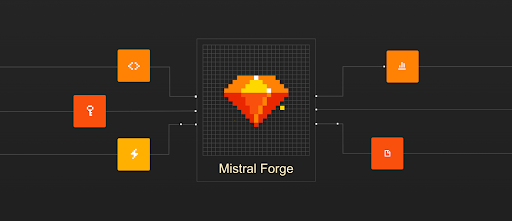
Mistral AI, the French startup known for challenging the traditional AI landscape, announced Forge, “a system for enterprises to build frontier-grade AI models grounded in their proprietary knowledge,” on March 17, 2026.
Founded in April 2023 by Arthur Mensch, formerly of Google DeepMind, alongside Guillaume Lample and Timothée Lacroix, both formerly of Meta AI, Mistral AI has become one of Europe’s leading generative AI developers.
What set the company apart from the beginning was a simple but deliberate choice: to keep its models open. While most AI firms have built walls around their technology, Mistral let developers, businesses and researchers in – free to use it, adapt it, build on it.
As of June 2024, Mistral was the largest AI startup in Europe by valuation, and the largest outside the San Francisco Bay Area. Its flagship model, Mistral Large 2, released in September 2024, has outperformed most open models on common benchmarks – rivaling several leading closed systems – while supporting context windows of up to 128,000 tokens across multiple programming and natural languages.
Despite raising over $3 billion USD (€2.62 billion) total – securing $830 million (€725 million) this week alone for a new data center near Paris – and reaching multi-billion-dollar valuation, Mistral has maintained its independent, declining acquisition offers from larger tech companies.
From general-purpose to enterprise-specific
Forge addresses a fundamental gap in enterprise AI: most models are trained on publicly-available data and optimized for general use, but enterprises run on internal knowledge.
“Forge bridges the gap between generic AI and enterprise-specific needs. Instead of relying on broad public data, organizations can train models that understand their internal context, embedded within systems, workflows, and policies, aligning AI with their operations,” the company stated.
With it, then, organizations can train models on their own documentation, codebases, structured data, and operational records, producing systems that understand their specific vocabulary, workflows, and policies rather than relying on broad public datasets.
Keeping control in-house
This level of control matters most when it is non-negotiable. In regulated industries, for instance, AI models must reflect compliance obligations, governance frameworks, and operational constraints.
Forge allows companies to govern models through internal policies and evaluation standards, keeping sensitive knowledge within their own infrastructure – with no need to transfer proprietary data to external providers.
As AI becomes embedded in core enterprise systems, Forge offers something increasingly rare: genuine strategic autonomy over how a company’s knowledge is encoded, deployed, and owned.
Featured image: Via Mistral AI.