



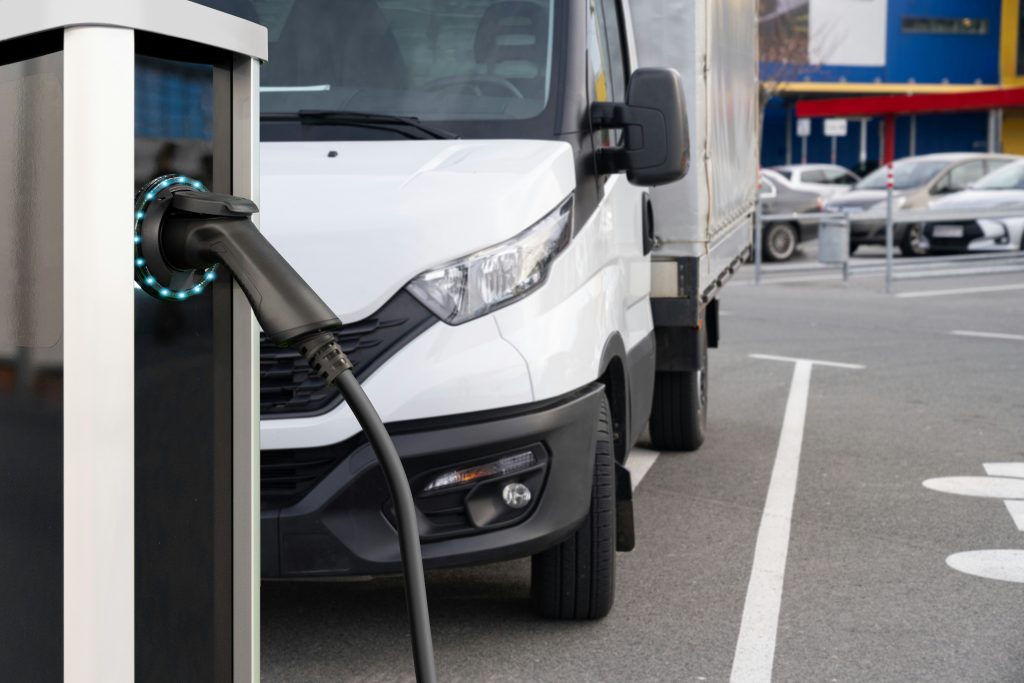
As more fleets turn to electric vehicles in Europe, it’s worth asking just how drivers are experiencing the transition. The transition from diesel to electric freight transport isn’t simply a matter of switching vehicles; it changes how routes are planned, where drivers stop, how they take breaks, and how they interact with their vehicles throughout their shift.
And as fleets electrify, software increasingly sits at the center of these decisions, which could compound stress for the drivers if poorly planned. But are stressed drivers truly top of mind for EV software makers?
The answer appears to be evolving. While early EV software focused primarily on batteries and route planning, a growing number of providers are recognizing that successful electrification depends just as much on driver experience as it does on vehicle performance.
Effective scheduling is more than route optimization
Scheduling has always been a complex balancing act for freight operations. Fleet managers have to account for delivery windows, traffic conditions, vehicle availability, as well as region-specific driver regulations. Electrification, though, adds another variable: EV charging.
At first glance, charging might appear easy to integrate into a schedule: drivers can simply recharge while taking mandatory rest breaks. In reality, however, human behavior rarely fits neatly into its optimization models.
Graeme Morrison, head of software at UK-based electric truck leasing and charging infrastructure firm PragmaCharge, spoke to 150sec about how software directly needs to consider fleet drivers’ considerations when building features. “Before we deploy any truck or charger, we do a lot of upfront analytics with customers’ existing operations to understand how and where they operate today. We plan how many electric trucks they should take, of what type, where they need charging infrastructure, how to right-size that infrastructure, what routes they should run, and ultimately how much it is all going to cost.”
“After deployment, customers are supported by our real-time platform: PragmaCharge Cloud Engine. It brings in live telematics data from the trucks we’ve deployed, live data from our chargers and charging network, and will soon connect to our customers’ transport management systems as well,” he added.
Founded in 2022, PragmaCharge provides electric-trucking-as-a-service for existing freight carriers and operators of diesel trucks looking to transition their fleet to electric. The offering includes private depot infrastructure in some cases, but also building semi-public multi-tenant hubs at key logistics sites within Europe.
The company argues that driver schedules must be considered alongside vehicle constraints, rather than treated as a secondary consideration.
“We’re well aware of the range anxiety problem,” Morrison said, “there are also other challenges. For example, there is a lot of discussion around optimizing driver schedules so that charging coincides with mandatory rest breaks. But this doesn’t necessarily always suit drivers’ preferences: some may prefer to take their breaks out on the road rather than back at the depot.”
This highlights a challenge facing the industry. The most efficient schedule might not be the most human one for drivers. Software that ignores these organic preferences risks creating friction, reducing adoption, and potentially increasing driver stress.
Reducing range anxiety through better information
Driver stress is influenced by more than just scheduling. Many drivers are encountering new technologies for the first time, including regenerative braking systems, battery management tools, route-aware navigation, and charging applications. And while these technologies can improve efficiency, they can also create information overload if poorly designed.
Of all of the anxieties described by drivers, range anxiety remains one of the most persistent concerns in electric transportation.
While modern electric trucks continue to improve their range autonomies, the perception of being stranded with zero charge can be just as important as the actual performance. Drivers and fleet managers need a boost of confidence that vehicles can complete assigned routes without unexpected disruptions.
“The goal is to provide fleet operators and drivers with day-to-day decision support, optimize truck utilization, help achieve TCO parity with diesel, ensure reliability, address issues such as range anxiety, and help us manage charging infrastructure more predictably,” Morrison said about the importance of addressing range anxiety, adding that such an approach allows his team to manage energy allocation, minimize energy costs, and pass savings onto customers.
To produce more accurate range predictions, modern platforms increasingly use real-time vehicle data, traffic information, route characteristics, weather conditions, and charger availability, which allows operators to move beyond simplistic battery percentage calculations and instead make decisions based on realistic operating conditions.
However, Morrison argued that range is only one piece of a broader operational puzzle.“The software landscape for planning and managing electric trucking operations is still relatively young. Most solutions focus on truck scheduling, range, and battery capacity; few treat driver scheduling, shift patterns, or rest requirements as a first-class part of the problem.
“We’ve found many situations where a route initially looks viable based on truck range, but when you factor in driver schedules it simply doesn’t work from an economic perspective today,” he further stressed.
The observation underscores an important lesson for the industry: solving range anxiety alone isn’t enough. A route that works on paper has to also work for the people driving it.
Putting drivers at the center of electrification
Electric trucking software has matured rapidly in recent years, but much of the industry remains focused on vehicles and infrastructure. Those elements might be essential, but the human component is equally important.
The next generation of EV fleet software will likely be judged not only on how efficiently it manages batteries and chargers, but on how effectively it supports the drivers behind the wheel.
Scheduling flexibility, intuitive decision support and realistic operational planning may ultimately prove just as valuable as advances in vehicle technology; if electric trucking is to scale successfully, software makers will need to remember that every route, battery, and charging session ultimately revolves around a person trying to do their job efficiently and safely.
For many fleet operators, reducing driver stress may become one of the most important metrics to keep top of mind.
Featured image: Getty Images via Unsplash+

Disclosure: This article mentions clients of an Espacio portfolio company.