


A January 2026 study found that artificial intelligence (AI) systems emitted as much carbon in 2025 as the whole of New York City, and estimates that AI-related greenhouse gasses now equal over 8% of global aviation emissions.
Despite these staggering figures, demand for AI and AI-related roles keeps surging – while big tech moguls including Amazon, Google, and Microsoft continue building resource-consuming data centres.
AI’s resource demand
The world’s most popular AI chatbot, OpenAI’s ChatGPT, processes 2.5 billion requests daily – 29,000 per second. Each query uses 0.3 watt-hours of energy – about the same as a running LED bulb for a couple of minutes. At that scale, it adds up – fast.
Data centers alone consumed 4.4% of the U.S.’s electricity in 2023, while the country’s Department of Energy projects such power consumption could triple by 2028. Penn State computer science professor Mahmut Kandemir, in fact, warned that data centers could account for 20% of global electricity use by 2030-2035.
And it’s not just an energy problem. Graphics Processing Units (GPUs), chips central to AI hardware, require enormous amounts of water for cooling systems. One report by the UK’s Government Digital Sustainability Alliance projects AI could drive global water usage from 1.1 billion cubic metres to 6.6 billion by 2027.
Swap chips for brain cells?
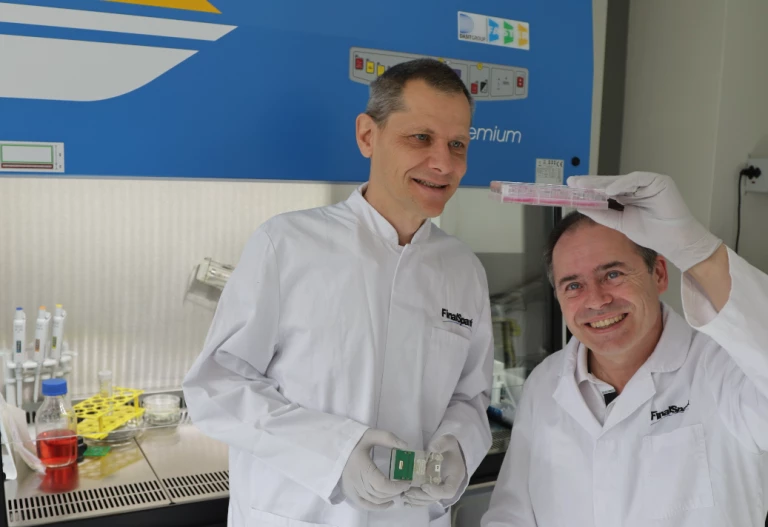
Some researchers think biology might be the answer. For one, Swiss startup FinalSpark is developing computers powered by living human neurons instead of traditional silicon chips.
“AI consumes a lot of energy. If AI worked with living neurons, then there would be a huge decrease in the whole consumption,” said Dr. Fred Jordan, co-founder of FinalSpark and PhD in signal processing from Switzerland’s Ecole Polytechnique Fédérale de Lausanne.
The startup’s plan is not to have living computers replace data centers tomorrow – but that the technology could eventually deliver powerful computation at a tiny fraction of today’s energy cost.
Life of a neuron
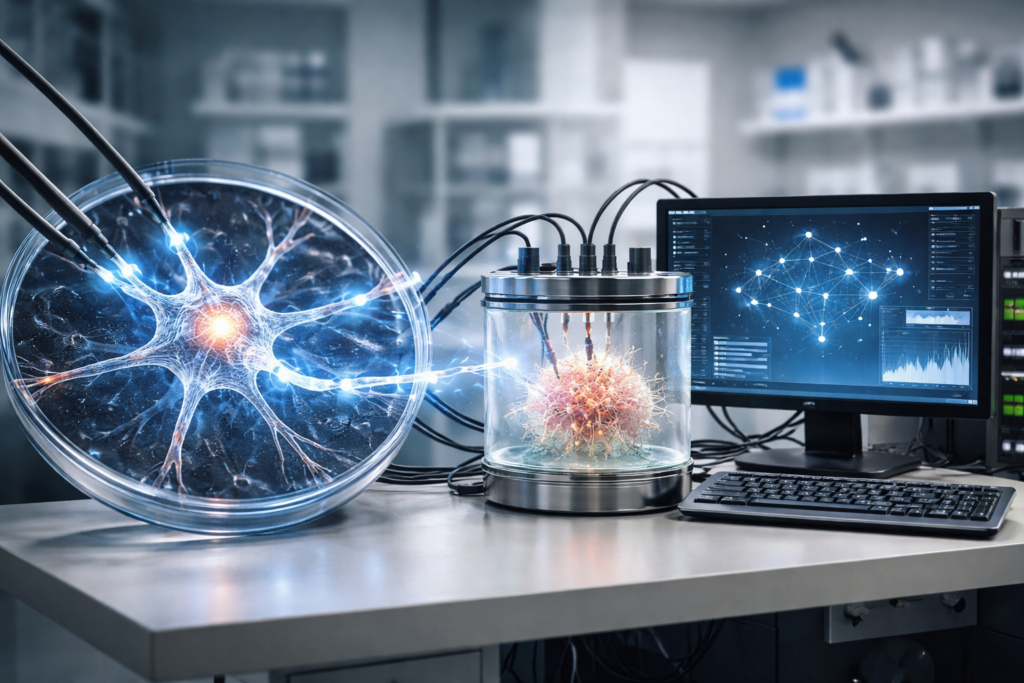
Neurons start as stem cells, frozen in liquid nitrogen. Once thawed and moved into a liquid environment, they begin forming the familiar shape of a neuron – a central body with branching extensions – within about a week.
Scientists then add molecules that allow the cells to connect and generate electrical activity.
The whole setup is often called “wetware,” and FinalSpark has already extended neuron lifespan from a few hours to eight months.
“They are a perfect sphere,” Dr. Jordan explained. “A few years ago, this was about a few hours.”
The big open question
The technology raises ethical questions that researchers are taking seriously. Dr. Jordan noted unusual spikes in neural activity in the final moments of a neuron’s life – a pattern that draws comparisons to activity observed near death in humans.
“It’s not clear if it is ethical to use them. This is a philosophical and ethical question, and we are building partnerships with universities to initiate the discussion,” he stressed.
Beyond the neurons themselves, however, part of the ethical debate relates to donor consent.
A growing field beyond the lab
While FinalSpark is a pioneer in Europe, there are other researchers across the globe working on the field.
Australian startup Cortical Labs taught neurons to play the classic computer game Pong. Similarly, in the U.S., scientists at Johns Hopkins University are also developing “mini-brains” to examine the way neurons process information – with potential applications for Alzheimer’s and autism research.
The science is still early. Yet, as AI’s energy costs keep climbing, the idea of powering it with living cells is starting to look less like science fiction and more like a necessary leap forward.