



Europe produces 517 kilograms of waste per person every year, yet less than half of it ends up recycled. And, for decades, European populations have treated garbage as a logistics problem – a matter of moving or burying trash – which has left the industry as one of the least digitised in the world.
Waste management is often relegated to the background as an additional step in urban planning, although in reality, it is the silent engine of the European Green Deal – an effort to make the EU climate-neutral.
When the neglected waste systems fail, however, the effects ripple through every environmental pillar: contaminating local ecosystems, inflating methane emissions, and stalling the transition to a circular economy.
To treat waste as an afterthought is to ignore the primary data stream of a city’s health, which then affects every other industry regardless of whether it’s directly related or not.
But a quiet coup is underway as the region tightens its circular economy targets. Women are turning trash into intelligence, and proving that the waste problem is actually a data problem.
This female-driven reckoning is not by chance, either. Researchers found in 2026 that women in Europe consistently exhibit higher levels of environmental concern, worry about the impact of climate change, and express greater support for environment-friendly solutions – invariably “outgreening” men in diverse measures and contexts across the past two decades.
Women, in fact, are more willing and participate more actively than their male counterparts in waste management specifically – in most cases adopting recycling practices more frequently.
While the traditional industry is still zeroed in on utilizing the environment, women are increasingly leveraging emerging technologies – including AI – to protect it. By focusing on accountability over throughput, they are finally turning on the lights in a black box industry.
Rebuilding the foundation
The most rapid and demanding shift is happening in the physical operations of the waste management industry.
In this space, Norwegian Julie Haga, head of engineering at AI-powered waste analytics firm Sensorita, represents a new leadership model which leverages emerging technologies to build waste management systems ground-up.
Haga believes that fixing the system requires becoming the system. Having previously worked on sensors for containers where adoption was slow, she moved into total operational control.
“Sensorita used to sell software to waste companies. Now we are the waste company. That shift, from vendor to operator, is what full-stack AI actually means,” she said on LinkedIn. “Instead of waiting for a slow-moving industry to adopt our technology, we are using it to become a competitor.”
Her work is a testament to how the most effective way to modernize a city is to lead from this front: by integrating AI directly into collection logistics, she accelerates deployment in an industry notorious for delayed adoption.
“We’ve seen enormous potential to use technology to increase productivity. But the large companies are trapped in legacy systems, migrations and outdated business models,” she stressed.
Radical transparency in the machine
While Sensorita re-engineers the trucks on the street, Mikela Druckman is staging a technical intervention inside the recycling facilities. As the co-founder of AI waste analytics company Greyparrot, Druckman targeted the most opaque part of the chain: the sorting process.
In most traditional plants, manual sampling covers barely 1% of the waste stream, while the quantity keeps increasing.
By integrating modern information systems with collection logistics, innovators are increasingly closing the digitisation gap in an industry historically defined by its lack of real-time data.
“People are learning how to use statistics and AI to make better decisions in industries where there was almost zero digitization before us,” Ambarish Mitra, business partner of Druckman at Greyparrot, explained.
Greyparrot’s computer vision systems analyse waste in real time, generating data that makes it impossible to hide inefficiencies. Druckman’s impact goes beyond the technology itself, however, as she pushes for the kind of transparency that has historically been in short supply: making the invisible visible, and ensuring Europe’s recycling targets are built on hard data instead of optimistic estimates.
For her, visibility is the only way to build a functional circular economy.
The €20-billion bottleneck
When addressing Europe’s waste problem, the funding gap remains the biggest obstacle. Women leading the charge drive the most nuanced sustainability solutions, yet still struggle to secure capital.
European AI investment totaled €23.5 billion last year, but only €3 billion reached women-founded startups; this disparity is a direct threat to the region’s environmental targets.
Adéla Hofmannová, researcher at the Czech Technical University in Prague, notes that technology can improve efficiency, but it rarely replaces underlying systems overnight. This issue requires “stronger relationships between society and government” to achieve a sustainable future.
This re-engineering, however, is often blocked by industrial inertia. Haga, while speaking with 150sec, found that while big waste companies often claim to believe in the potential of new technology, they struggle to actually implement it because they are “trapped in their way of working”.
Starving the founders who bring the greatest conscientiousness to this task means slowing the green transition itself, which the EU has formalized through the European Green Deal – under which waste and product reforms are a prioritized area.
On the other hand, ignoring the funding gap also entails disregarding the very people who correctly diagnosed the flaws in European waste systems; Haga, Druckman, and others are defining how EU cities breathe; to fund these women is to fund a version of AI that is as concerned with social accountability as it is with technical efficiency.
Women aren’t just reshaping the future of recycling, but also building its new foundations.
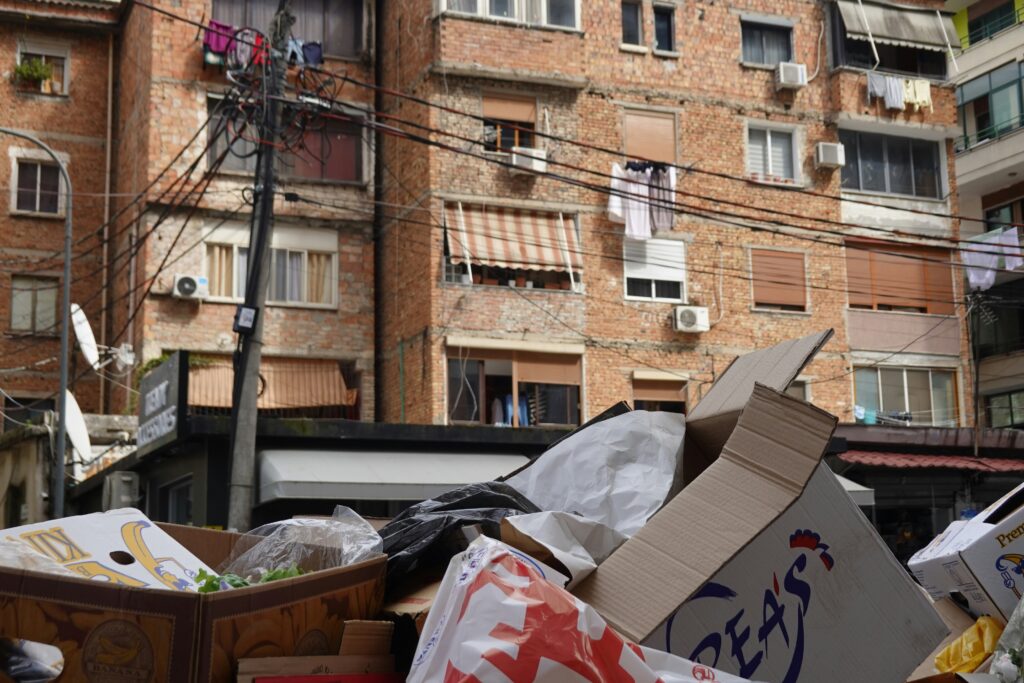
Featured image: Overflowing recycling containers and cardboard waste in Tirana, Albania, with tangled overhead cables and a weathered brick apartment block in the background—an everyday snapshot of urban waste management and city living.
Author: Energie-portal.sk
License: Via Unsplash+