


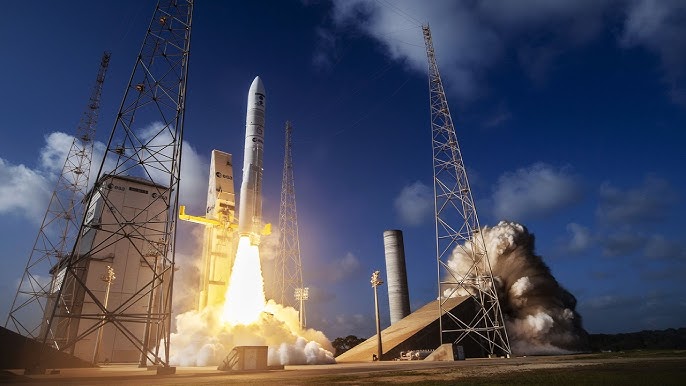
The European Space Agency (ESA) is reviewing whether Europe’s current rocket capacity can meet a satellite launch market that could peak around 2030, with director general Josef Aschbacher acknowledging the agency has not yet decided whether to raise its launch rate.
The question is not hypothetical. Amazon has already commissioned 18 launches on top of Arianespace’s projected nine or ten annual Ariane 6 flights from 2027, and ESA is separately funding a handful of new European rocket companies to widen supply beyond Ariane 6 and Vega-C, the region’s two current workhorse rockets, used respectively for larger and smaller satellite payloads.
“We need to make a decision pretty soon,” ESA director general Josef Aschbacher said, as per Reuters, though no approved target for a higher annual launch rate currently exists.
ESA weighs capacity as demand climbs
France-based Arianespace, the world’s first commercial launch provider founded in 1980, currently projects nine or ten Ariane 6 launches each year from 2027. Amazon has already commissioned 18 launches, giving Europe a substantial confirmed commercial launch requirement, and ESA continues to use Ariane 6 and Vega-C for institutional missions.
Arianespace CEO David Cavaillolès has described Amazon as the company’s largest single customer, saying “our main and biggest client today is Amazon.”
“Can we satisfy all these launches?” Aschbacher asked while describing the ongoing review, confirming that ESA has not yet made a decision on expanding launch capacity.
ESA expects satellite launch demand to rise sharply and potentially peak around 2030, a forecast that includes European institutional missions and possible additional commercial demand, though the final number of required launches remains uncertain.
Future Amazon orders and other commercial missions could add further pressure on available launch slots, meaning the limited windows and pad time each rocket needs to prepare for and carry out for launch, though those additional missions have not yet been confirmed in the information ESA has presented.
Any production expansion would also require decisions on factories, suppliers, infrastructure, and launch operations.
Aiming for widening supply
On the supply side, Europe has moved further than the demand question alone suggests. ESA has signed contracts under the European Launcher Challenge, an ESA funding program that supports smaller private rocker companies so that Europe has more launch options, with several private launch providers: Rocket Factory Augsburg received €186.9 million, while PLD Space secured €158.9 million. Isar Aerospace received €197.8 million for development and launch-related work.
ESA’s director of space transportation, Géraldine Naja, called the awards the start of a broader push, saying the program “kicks off the European Launcher Challenge, encouraging competition among European launch providers.”
Meanwhile, Isar Aerospace’s chief commercial officer, Stella Guillen, framed the contract in strategic terms, stating that “Europe is putting serious resources behind its space sovereignty.”
PLD Space’s executive president, Ezequiel Sánchez, described the award as validation of the company’s longer-term plan, saying it “confirms the maturity of the roadmap we have been building for years.”
Participating companies must achieve an orbital launch before 2028 under the program’s requirements, and successful launches could broaden Europe’s available launch services beyond Ariane 6 and Vega-C.
Rocker Factory’s RFA One currently targets payloads of up to 500 kilograms to a 500-kilometre sun-synchronous orbit, an orbit that passes over the same point on Earth at the same local time each day, commonly used for Earth observation and weather satellites. PLD Space’s Miura 5 targets about 540 kilograms to a sun-synchronous orbit. Isar Aerospace says Spectrum targets payloads of up to 1,000 kilograms to low Earth orbit.
These payload figures represent planned vehicle capabilities rather than established operational launch records, and none of the three companies has yet reached orbit. ESA also expects its contract process with MaiaSpace, an ArianeGroup-backed rocket startup and the fourth company in the European Launcher Challenge program, to continue, but that award remains incomplete.
Featured image: Arianespace via Youtube