



Europe has a structural talent shortage, and London Tech Week and London Latam Conference showed that the conversation is no longer just about AI, capital, or innovation, but about who is going to build that technology.
The pressure is structural: the EU has set a target of 20 million ICT specialists employed by 2030, but its own State of the Digital Decade report projects only 12 million will be available — a shortfall of nearly 8 million workers. In the UK specifically, 76% of employers report difficulty filling roles, and research from the University of Birmingham warns that digital skills shortages could put 380,000 full-time equivalent jobs at risk and cost the economy up to £27.6 billion by 2030. London, as the continent’s largest tech hub, sits at the center of that pressure, and this June it hosted two events that, together, pointed toward where part of the answer might come from.
London Tech Week had all the familiar buzz with hundreds of people talking about issues related to artificial intelligence, quantum computing, and enterprise transformation. A couple of days later and miles apart from each other was LoLa, which focused on a more specific question: how should Europe build its next generation of technology companies, and with whom?
That second question is the more telling one. Latin America has moved from being a region occasionally discussed at London Tech Week to becoming part of the conversation actively shaping Europe’s technology ecosystem — not as a market to invest in from a distance, but as a partner in how companies are actually built.
The event took place on June 8 to 10 at Olympia London. Organized by Informa Tech together with London & Partners, and based on the success of its 2025 event. Microsoft and AWS returned as Headline Partners, and sessions across the AI Arena and Transformation Stage centered on sovereign AI, quantum computing, automation, and the future of mobility- the technology side of the story.
LoLa joins the agenda
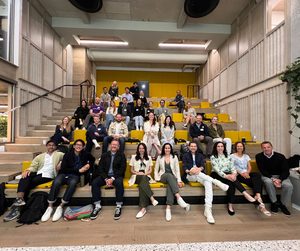
While London’s main stages focused on AI, automation, and enterprise transformation, a smaller event running alongside the festival explored another question: how Europe and Latin America can build technology companies together. Held June 11 at Hult International Business School and organized by Pygma, Capricornio Capital, and Briter, LoLa was a smaller side event focused specifically on cross-border collaboration, bringing founders, investors, and operators together for a day centered on capital raising, international expansion, and partnership models between the two regions.
Latin American startups have seen $4.126 billion raised in 2025 with year-over-year growth of 13.8%, as indicated by the Latin America VC Report 2026 from Cuantico VP and Startuplinks. This was the region’s first real rebound since 2021. The growth, however, is selective: few deals but large investments, with Brazil and Mexico alone taking almost 80% of all money. This is what Daniel Ospina, one of LoLa organizers, described as Latin America finally leaving its “grow fast” mindset behind in favor of growing sustainable companies on a global level, with London serving as an increasingly important gateway for that next stage.
A founder’s view: talent, not geography
Hiring was another recurring theme throughout the discussions. For Pablo Miller, founder of workforce platform Remoti, the conversation around capital misses half the picture. Miller has spent the years since founding the company at 22, after a trip to Bogotá convinced him Latin America’s talent was being overlooked, arguing that the real shift underway isn’t where money flows, but where work itself gets done. “Companies are no longer hiring globally because it’s easier,” he says. “They’re hiring globally because talent is distributed.” Geography, in his view, has stopped being a useful predictor of performance: enterprise leaders, he notes, consistently report that Latin American teams are outperforming expectations.

It is in this regard that Miller comes out as one of the sharpest thinkers on the nature of the relationship between the UK and LATAM. While the narrative of the LoLa stage often revolves around issues of capital and exits, Miller constantly brings the discussion back to an aspect that may be less obvious: the talent and execution infrastructure needed for those investments to have an impact in reality. Miller’s point, in essence, is that money attracts attention, but hiring talent is how the bridge actually gets built. So, that relationship between the two hemispheres should be seen as complementary. As he put it in reflections on the week, the future isn’t “London or Latin America,” but “London and Latin America”. Where the British product vision and leadership are combined with teams in Bogotá, Medellín, Mexico City, and Buenos Aires. This allows companies to operate and execute across more of the day.
He’s also candid about where the real obstacle lies. It isn’t technical, and it isn’t financial. It’s that many companies simply don’t realize how mature the ecosystem connecting the two regions has already become. Closing that gap, he suggests, is precisely what events like LoLa are for, putting ecosystem builders and operators in the same room until the connection stops needing to be explained.
What’s next
London Tech Week spent its main stages debating where technology is headed. A few miles away, LoLa spent a day debating who gets to build it. For European readers watching their own talent pipelines tighten, that second question may be the more consequential one. As Miller puts it: “One of the biggest challenges in B2B is helping companies understand that there’s a strong ecosystem connecting Latin America and Europe, particularly in the UK. Organizations like LoLa and other ecosystem builders play a critical role in bridging that gap by helping investors and companies better understand the Latin American market.” That gap-closing work is exactly what LoLa’s first edition set out to do — and, with Pygma already planning a similar event for New York Tech Week, it won’t be the last.