


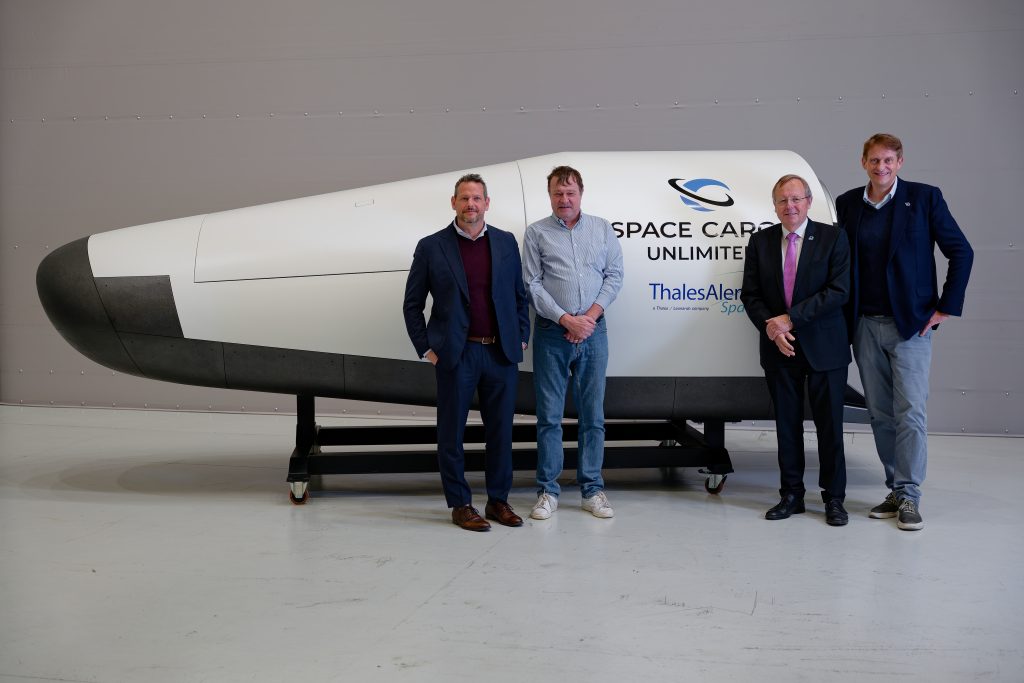
Space Cargo Unlimited is moving closer to establishing dedicated infrastructure for commercial manufacturing and research in microgravity, unveiling a full-scale development model of its REV1 spacecraft for the first time at Space Tech Expo Europe in Bremen, Germany.
The vehicle, privately funded by Space Cargo Unlimited and co-developed with Thales Alenia Space, is designed to support industrial operations in orbit, including research, material processing and the return of payloads to Earth. REV1 is targeting flight readiness in 2030, subject to development and qualification milestones.
First announced in 2022, REV1 represents the next stage in Space Cargo Unlimited’s efforts to develop reusable spacecraft around commercial demand. The company is designing the vehicle around its BentoBox platform, a modular system intended to accommodate customer equipment and industrial processes in microgravity.
The development model is already supporting work on the spacecraft’s active thermal systems, while manufacturing is underway on the mechanisms required to integrate BentoBox into its structure. The progress marks a transition from the initial concept towards a more advanced phase of spacecraft development.
Demand is emerging across several industries, particularly pharmaceuticals, biotechnology, advanced materials and semiconductors. Space Cargo Unlimited reports that it is in active discussions with more than 150 customers and prospects, approximately 40% of which operate in life sciences and biotechnology.
Nicolas Gaume, co-founder and CEO of Space Cargo Unlimited, said the spacecraft is being developed to address the infrastructure requirements that have limited the expansion of commercial activities in orbit.
“We have always believed that microgravity can become a new environment for industry, but that potential depends on building the right infrastructure. With BentoBox, we are developing the space factory that can fly across a fleet of vehicles. REV1 is being designed from the inside out to take this BentoBox capability even further, around the equipment and processes our customers need. Our ambition is to bring space closer to industry and, ultimately, create value for the customers of our customers. We know how hard that is, and we approach it with humility and determination,” Gaume said.
BentoBox platform underpins REV1’s commercial manufacturing capabilities
The spacecraft’s architecture is built around BentoBox, Space Cargo Unlimited’s standardized, modular platform for payload integration and in-space operations. The system is intended to provide companies with an environment in which they can operate their own equipment and processes under microgravity conditions, extending access to orbital infrastructure beyond traditional space-sector customers.
Its capabilities address operational requirements that go beyond payload capacity. These include late access for time-sensitive materials, such as biological samples, and vibration and load mitigation designed to protect sensitive equipment during launch and return.
BentoBox is also being developed with continuous monitoring, data logging and real-time sensor feedback, giving customers greater visibility into their processes while operating in orbit. Additional capabilities include controlled pressurization, temperature management, thermal and cooling-loop control, and power distribution.
For applications in regulated industries such as pharmaceuticals and biotechnology, the platform is intended to support certified pathways for biological payloads and chain-of-custody requirements. Onboard autonomy and edge-computing capabilities are also part of its development, with the aim of helping customers optimize processes without relying exclusively on ground-based intervention.
REV1 is designed to expand these capabilities by providing the additional space, power and operational resources required for larger payloads and longer missions. The spacecraft is expected to offer tonne-class payload capacity, 1,200 liters of pressurized internal volume and 2.5 kW of shared continuous power. Its missions are designed to last between several weeks and six months, depending on customer requirements and applications.
The vehicle will feature a reusable, two-module architecture. Its Orbital Module will provide power and operational services in space, while the Re-entry Module will transport payloads back to Earth for retrieval, refurbishment and potential reuse. This approach is intended to support repeated missions and establish the operational cadence required for commercial manufacturing at scale.
Thales Alenia Space is contributing its engineering and development expertise to the program, drawing on more than four decades of experience in space exploration and re-entry technologies.
Roberto Angelini, vice president of Exploration and Science at Thales Alenia Space, said: “The current development module is already helping the evolution of the active thermal systems of the vehicle, while proceeding with the manufacturing of the mechanisms to integrate Space Cargo Unlimited’ BentoBox inside its structure. Thales Alenia Space’s teams are investing the company’s experience and know-how gathered in over 40 years in space exploration and re-entry solutions, to foster the unique features of BentoBox, supporting Space Cargo Unlimited’ vision and mission.”
Partner missions will build operational experience ahead of REV1’s debut
Before REV1 enters service, Space Cargo Unlimited is using partner spacecraft to test BentoBox in orbit, validate its interfaces and establish the processes needed for recurring commercial missions.
The company plans to fly BentoBox aboard ATMOS Phoenix 2.1 in 2027. A separate one-tonne BentoBox mission aboard SpaceX’s Starfall re-entry vehicle is scheduled for no earlier than 2028. These missions are expected to provide flight experience and operational data that can inform the development of REV1 and its future commercial applications.
The strategy allows Space Cargo Unlimited to develop its modular platform and build customer experience while the dedicated spacecraft moves through its engineering and manufacturing phases. It also supports the company’s broader ambition of operating BentoBox across a fleet of vehicles rather than relying on a single spacecraft.
The unveiling in Bremen therefore marks more than the presentation of a new spacecraft model. It signals progress towards an industrial infrastructure designed to make microgravity research and manufacturing more accessible to companies outside the traditional space industry.
By combining a reusable vehicle with a standardized platform for customer equipment, Space Cargo Unlimited is seeking to establish a repeatable model for conducting experiments, developing materials and returning products to Earth. Whether the model can achieve commercial scale will depend on technical qualification, mission reliability and the ability to convert growing customer interest into sustained demand.