


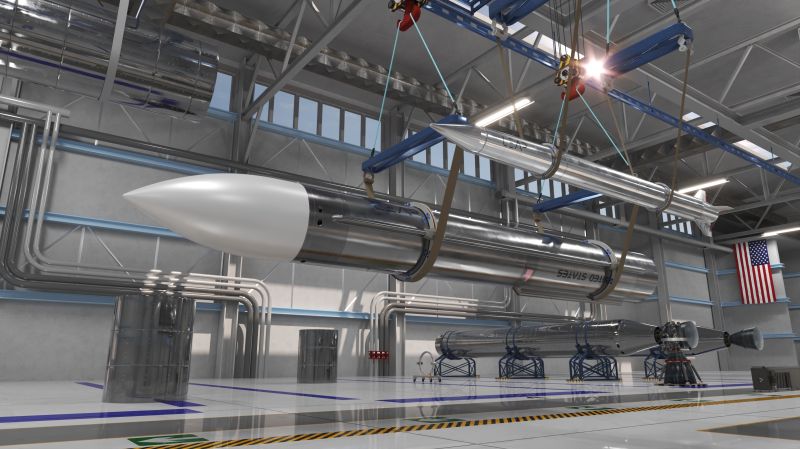
U.S. rocket company LEAP has signed a Memorandum of Understanding with Highlands and Islands Enterprise (HIE) to develop recurring launches from Sutherland Spaceport, on Scotland’s far northern coast.
If the plans go ahead, the Colorado firm would use the site as its first launch base outside the United States and its springboard into a European market where demand for rockets is rising much faster than supply.
For Sutherland, the timing could hardly be better. A year ago, the site looked finished. Orbex, the Scottish rocket maker that held the lease, had already walked away from it before collapsing into administration in February, leaving behind planning permission, a lease on crofting land and very little built.
HIE, the regional development agency that first proposed the spaceport in 2018, bought the assets back from the liquidators in August. LEAP is the first operator to put its name to the site since.
LEAP’s own pitch is unusual for a launch company. It describes itself as a logistics business, building cheap, mass-producible rockets that can move cargo anywhere on Earth or into orbit within minutes. Its first vehicle, Bullfrog, flew from the Mojave Desert in May, and the company has been courting the UK since Space-Comm Glasgow in 2025, visiting sites from Machrihanish to Inverness and meeting the UK Space Agency, the Civil Aviation Authority and the Scottish Government along the way.
The new agreement is the clearest sign yet that LEAP sees the UK as its European home.
What the agreement covers
LEAP plans to start with Bullfrog at Sutherland, then move on to Bighorn, its larger vehicle for suborbital, point-to-point and orbital missions. The long-term goal is a regular launch cadence from the site rather than a one-off flight.
Under the MOU, the two organisations will set up a dedicated workstream to work out a practical route to that first launch. The conversations go further than the launch pad, covering possible manufacturing and test work in the Highlands and Islands, supply chain deals, local hiring and university partnerships.
The agreement is non-binding, and any launch will still need technical assessment, regulatory approval and final commercial contracts.
“Sutherland is an ideal starting point for a network that begins in Europe,” said LEAP CEO Chris Beckman.
The company is betting on volume as well. Each of its modular factories is designed to turn out more than 30 vehicles a year, and its launch equipment is built to be packed up and moved to wherever customers need it.
Europe needs more rockets than it can build
LEAP is arriving as European officials sound increasingly worried about launch. In September, EU Space Commissioner Andrius Kubilius told the Access to Space Conference in Brussels that around 50,000 satellites are expected to go up worldwide over the next decade, pushing up both competition for launch slots and the prices operators pay for them.
The EU’s own needs are growing fast. Kubilius said the bloc’s launch demand could rise nearly sixfold by 2035, and national defence satellites are expected to climb from about 20 launched between 2016 and 2024 to nearly 300, while government satellites from about 70 to nearly 630.
Europe’s rockets can’t cover that. The EU expects to need 14 Ariane launches in 2031 alone, when Ariane is planned to fly ten times a year. Vega faces a similar gap, with eight launches needed in 2030 against six planned.
By mass sent to orbit, Europe sits fourth in the world, behind the United States, China and Russia, respectively.
Spending is picking up, though, and largely because of defence. The European Space Agency’s (ESA) 2026 Space Economy Report found that European space budgets grew 12% to €13.5 billion in 2025, even as global public space investment fell 3%. Private investment in European space companies slipped 8% to €1.4 billion, but that was still the second-highest year on record.
The European Commission has also proposed €131 billion for defence and space in the 2028 to 2034 EU budget, five times the current figure.
Where the UK and Scotland fit
The UK is outside the EU but still part of ESA, and its space industry is one of the largest in Europe. It brought in £18.6 billion (€22.3 billion) in income and employed 55,550 people in 2022-23, the most recent year covered by the government’s Size and Health report. Ministers have committed a further £2.8 billion (€2.9 billion) to the UK Space Agency through 2029-30.
Scotland punches above its size in that picture; it is home to roughly a fifth of UK space jobs, and Glasgow builds more small satellites than any other city in Europe. The Scottish space sector generated £381 million (€456.8 million) in income, according to the Scottish Government.
What the country still lacks is a launch; no vertical rocket has yet lifted off UK soil. SaxaVord in Shetland holds the only full licence, and Rocket Factory Augsburg’s maiden flight there has slipped more than once. Norway got there first, with Isar Aerospace recently flying Europe’s first commercial launch from Andøy on September 5, 2026.
HIE sees room for more than one Scottish site. “Sutherland is perfectly positioned to be used by a range of companies and help establish Scotland as a major centre of European spaceflight,” said David Oxley, the agency’s director of strategic projects.
Space Scotland CEO Dr. Natasha Nicholson said the jobs, investment and supply chain work that could follow “could deliver real economic value” for communities in the Highlands and Islands and businesses across Scotland.
Featured image: LEAP via LinkedIn
Disclosure: This article mentions a client of an Espacio portfolio company.