


A new October 2026 briefing by the European Parliamentary Research Service examines the copyright protection of AI-generated outputs and offers insight into the ongoing debates, not only in Europe but also from a comparative law perspective.
Drawing on directives, legislative proposals and policy documents from the European Union and other jurisdictions, the briefing highlights the importance of limiting copyright protection to human-created works and excluding purely AI-generated works from its scope.
Across jurisdictions, there is broad agreement that content generated entirely by AI does not qualify for copyright protection. Works created with the help of AI tools are a different matter, as they may still be protected where a human has exercised substantial creativity, though whether a work meets that threshold must be decided case by case.
“The proliferation of generative artificial intelligence (AI) technologies has given rise to new legal and policy challenges for the creative sector, and has prompted a fundamental re‑examination of copyright law, particularly its traditional concepts of authorship, originality and human creativity,” the document reads.
Generative AI is the most popular AI technology, with 51% of companies using it for content creation, customer support and process automation, according to Salesforce data. Its rapid growth, and what is expected to follow, raises legal questions at different stages of AI development; both over the material used to train the systems and over the output they produce.
Though copyright law faces new challenges today, with questions emerging around generative AI, it has long had to grapple with technological advancement. Since the Statute of Anne, the 1710 British law widely credited as the first copyright statute, copyright law has evolved alongside technology.
Intellectual property in general rests on a balance between protection and development. The concerns raised around the world, and those discussed in the briefing, go back to this foundation, including questions about the financial sustainability of the creative sector.
The EU framework
EU law has yet to settle whether AI-generate outputs can be protected by copyright. Directive (EU) 2019/790 on copyright in the Digital Single Market (the CDSM Directive) predates recent developments in AI, and does not set out a specific framework for copyright protection of AI-generated outputs.
The AI Act doesn’t resolve the question, either. It follows a product-safety approach and is silent on whether such outputs qualify for protection, even though it was adopted when the capabilities of AI models and the implications of their outpurs were already widely understood.
Nevertheless, the Act does impose copyright obligations on providers of general-purpose AI models, such as those powering popular chatbots. Under the Act, these companies must respect creators who have opted out of having their work used to train AI, a right EU copyright law already gives authors and rights holders.
They must also public a summary of the content used to train their models, giving creators a way to check whether their work may have been included.
Even though EU law does not specifically address whether AI-generated content may qualify for copyright or related rights protection, such protection is generally understood to extend only to human created works.
The Brief emphasizes that The Court of Justice of the European Union (CJEU) has consistently clarified the criteria for copyright eligibility through its case law, reaffirming an anthropocentric approach that places human authorship at the centre of copyright protection.
This approach aligns with natural-rights theories, which recognise individuals’ rights over creations of their intellect. As the briefing explains, “an original work reflects the author’s own intellectual creation, whereby an author has made free and creative choices.”
AI as a tool
Per the new briefing, when AI is used as a tool in the creative process, the resulting output may qualify for copyright protection where a human has made substantive creative choices, an approach in line with those adopted in many other jurisdictions, including rhw U.S., China, Japan, and South Korea. The UK, however, is a notable outlier, with its 1988 copyright law protecting “computer-generated works” even without a human author.
For the EU, then, the extent of human involvement can now be assessed by examining the degree of creative control exercised over the final output.
By contrast, under the current understanding of EU copyright law, outputs generated without human involvement, or through prompts with little to no subsequent refinement or modification are unlikely to receive copyright protection.
More elaborate prompting, along with selecting, modifying or otherwise reworking he output, may help show that the author made free and creative choices, though this depends on the circumstances of each case. This approach is intended to keep a balance between interests.
However, applying this principle in practice raises further questions: determining whether human involvement in an AI-assisted output is sufficient to demonstrate the originality required for copyright protection is far from straightforward.
Different jurisdictions, different rulings
Courts across the EU and beyond have already begun addressing this issue. In Germany, the Higher Regional Court of Düsseldorf held that an AI-generated product can qualify as a personal intellectual creation only if, it results from creative decisions made by the human user despite the software-controlled process. The case concerned an AI-generated work based on a photographer’s image.
The briefing also provides a comparative analysis of developments in other jurisdictions, including China and the U.S.
In China, the Feng Runjuan v. Kuashi Plastic case confirmed how high the bar can be. Feng, a designer, used Midjourney to generate images of a pink, butterfly-shaped children’s chair from a single short prompt, and shared both online in August 2023. Following licensing talks with a manufacturer falling through, the company used her public prompt to create similar designs and began selling the chairs.
The Zhangjiagang People’s Court dismissed her copyright claim in March 2025; Feng couldn’t recreate her original images with the same prompts because of the program’s randomness, which suggested to the court that the AI, not Feng, was making the design decisions.
It was the first Chinese ruling to explicitly deny copyright to content mostly generated by AI without substantial human input.
And in the U.S., the leading case is Thaler v. Perlmutter, where computer scientist Stephen Thaler tried to register an image created by his AI system, the “Creativity Machine”, listing the machine as its author. The Copyright Office refused, and the courts sided with it, with the district court holding that human authorship is a “bedrock requirement of copyright”. On March 2 this year, the U.S. Supreme Court declined to hear Thaler’s appeal, leaving the rule in place.
Still, the case only settles the question for works made entirely by AI. Because Thaler disclaimed any human creative input, the court did not address how much human involvement is enough to support copyright for AI-assisted works.
Competition in creative markets
Beyond the question of copyright protection for AI-generated outputs, the briefing notes that “there is growing evidence that the large-scale availability of AI-generated productions has substantially increased competition in the cultural and creative field”.
As AI-generated content becomes increasingly available and enters the market at scale, it may become a substitute for human-created works and compete with them for consumers’ attention, visibility, demand and revenue.
Even where AI-generated productions do not match original works in quality, their sheer volume and availability may reshape creative markets, affect the visibility of human creators and limit their opportunities to generate income. The extent and distribution of these effects, however, remain uncertain.
The lack of copyright protection may add to the pressure, too. Since purely AI-generated productions generally can’t be copyrighted, users may favor them over protected works to avoid licensing costs, which could shift demand towards content that can be used without permission or licensing fees.
This brings us back to one of the issues raised at the outset: AI-generated outputs may reproduce, incorporate or reflect elements of copyright-protected works used in training, which raises questions about whether—and how—authors and rights-holders should be remunerated for the use of their works.
Accordingly, the briefing touches on the discussions that have emerged around the possibility of establishing a remuneration system for those whose works have influenced or been incorporated into AI-generated outputs. However, the criteria for determining the extent of such influence, and how it should be assessed, remain to be defined.
What comes next
Many of the legal issues the briefing examines remain unresolved. Although jurisdictions differ in their approaches to AI regulation, ranging from more permissive to more restrictive, certain fundamental principles of copyright law remain central to these discussions.
As AI capabilities advance, both the copyright protection of AI-generated outputs and their growing presence in markets traditionally occupied by human creators have become increasingly significant concerns.
Whether the European Commission will revise the CDSM Directive or introduce new legislation to address these issues remains uncertain, as does the form any such initiative might take. In the meantime, attention should be paid to how the relevant provisions of the AI Act are implemented and applied in practice.
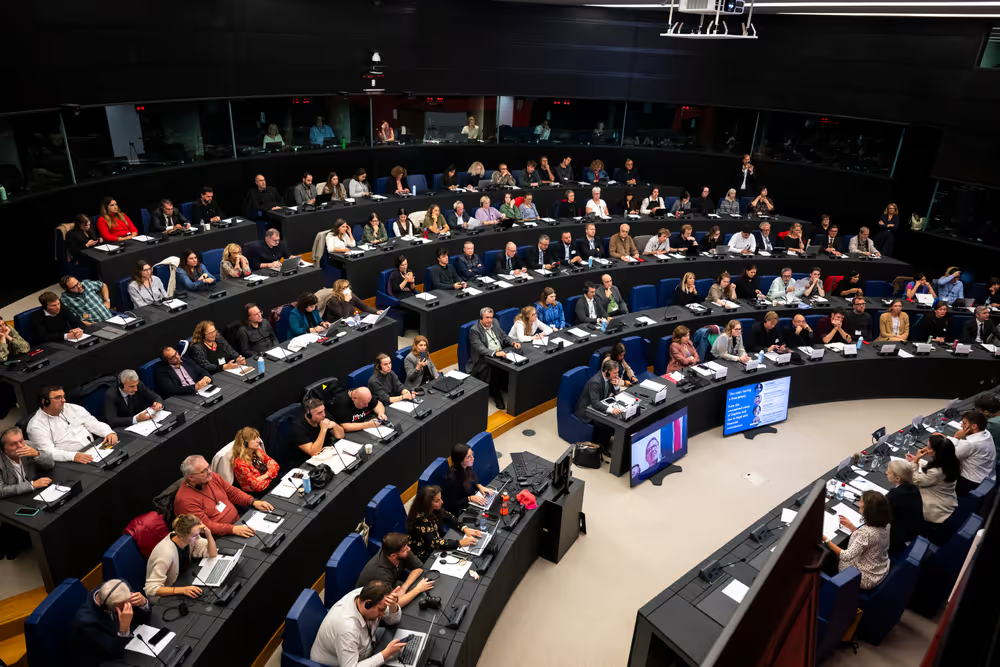
Featured image: Strasbourg’s Plenary session through the lens – October part II 2026
Author: Emilie GOMEZ
Source: Multimedia Europa
© European Union 2026 – Source : EP