


The steam engine, the electric motor, the telephone — all inventions that solidified Europe’s place as an architect of modern civilization during the first Industrial revolution.
But somewhere between the third and fourth industrial revolutions, Europe began ceding ground. US cloud providers came to dominate the European market, and when the AI boom arrived, they were front and center, alongside China and India.
That hype is settling, and quantum may be next.
For years, researchers labored to determine whether quantum physics could actually translate into real-world solutions. Today, countries are racing to get in—drawn by what quantum tech promises: unbreakable encryption for military communications, drug discovery, and smarter risk modeling in finance.
Aditya Singh, VP at BosonQ Psi, puts it plainly: “quantum-inspired algorithms are already solving problems that classical computing has been failing at for decades, in manufacturing, aerospace and defence.” For those with health concerns, Alice & Bob co-founder Théau Peronnin brings it closer to home. In his words, quantum technology “will make medicine an exact science.”
A theory Max Planck first defined in 1900 could be what returns Europe to the front of the line, not just in research, but in commercializing the technologies that define the next era.
The billion-euro bet
Europe’s interest in quantum technologies is not recent. Since the mid-1990s, the European Commission has invested close to €500 million into quantum research, through its Future and Emerging Technologies (FET) programme.
Research in this field gained momentum in 2016, after a group of scientists introduced the Quantum Manifesto—an initiative to “kickstart a competitive European quantum industry, positioning Europe as a leader in the future global industrial landscape.” The document outlined a 10-year plan, centered on four pillars of quantum technology: communication, simulators, sensors, and computers.
Two years later, that vision took shape as the Quantum Flagship, the EU’s €1 billion, decade-long programme with longer-term ambitions, engaging more than 5,000 researchers across the continent.
As regional collaborations progress, national governments are scaling their own quantum programs. In 2021, France launched a five-year plan worth €1.8 billion, tripling its yearly quantum investment. The German government has allocated over €2.6 billion since 2018, via research centers and corporate partnerships. Similarly, the U.K. has invested £1.1 billion in its National Quantum Technologies Programme, with an additional £2 billion pledged toward developing large-scale quantum computers by the early 2030s.
Public and private investment into Europe’s quantum sector is on the rise, and with it, an intra-continental competition of sorts. More European nations are formalizing their quantum strategies, with heavy funding to build fast—Spain is one of them. The Spanish government launched its first national quantum strategy in 2025, allocating €800 million to advance research and commercialization.
From the lab to the market
For decades, European quantum technology was confined within labs and research institutions. But today, procurement programs run by regional and national bodies, cross-border mergers and the possibility of public listings indicate that the quantum sector is warming up.
The European High-Performance Computing Joint Undertaking (EuroHPC JU) inaugurated its first quantum system in 2025, the PIAST-Q—a 20-qubit, laser-based supercomputer built by Austrian firm Alpine Quantum Technologies. Its most recently inaugurated system, Lucy, is a photonic quantum computer, developed by French firm Quandela, unveiled in 2026.
These milestones reveal a pattern: national governments and regional bodies are backing companies whose core technologies align with their strategic quantum priorities, from cryptography to fault-tolerant hardware.
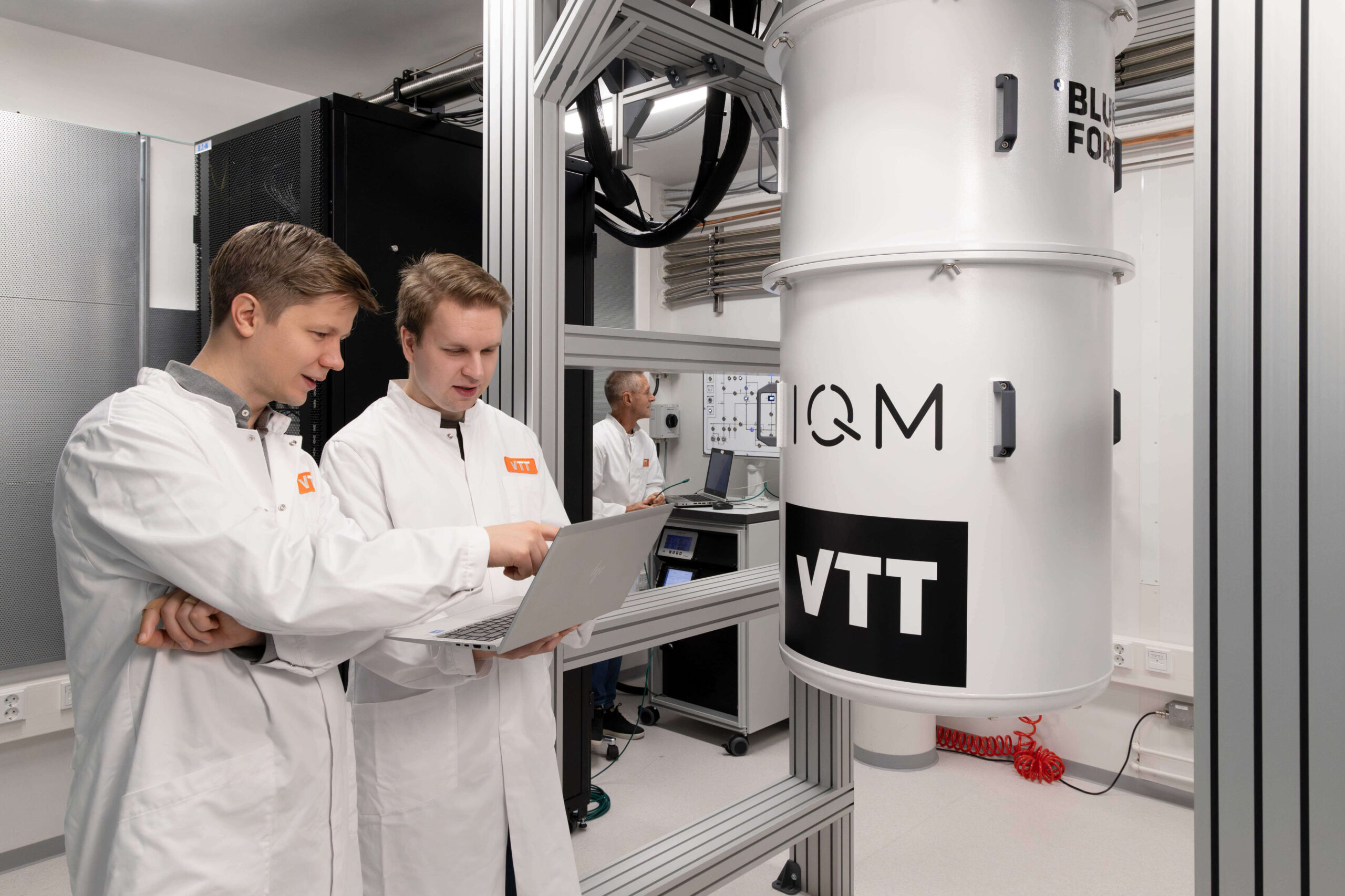
Finnish firm IQM is the clearest example. Founded in 2018, it was selected by Finland two years later to build the country’s first quantum computer, in a four-year partnership with VTT, the Finnish National Technical Research Centre.
Valued at €1.5 billion ($1.8 bn), IQM is set to become Europe’s first publicly listed quantum company, driven by demand for its on-premise quantum systems.
France’s Alice & Bob tells a similar story. In 2025, the firm raised €100 million in one of the largest Series B funding rounds in the European quantum sector. It is also among five startups selected for France’s PROQCIMA initiative, a decade-long competition with a €500 million fund, aimed at delivering fault-tolerant quantum computing.
The selection is a natural fit. Alice & Bob pioneered the cat qubit technology, a superconducting architecture that encodes quantum information in ‘Schrödinger cat states.’ Unlike conventional qubit architectures, it requires 60 times fewer physical qubits to run complex algorithms, significantly reducing hardware overhead.
The global quantum race: Europe and the rest of the world
When Canada’s D-Wave Systems announced the first commercial sale of a quantum computer to Lockheed Martin in 2011, it seemed like North America would, as it had in the decades since the Digital Revolution, lead the charge on the next tech frontier.
That expectation wasn’t unreasonable.
While Europe accounts for 31% of quantum computing firms globally, ahead of the US at 28% and China at 5%, most were founded after 2018, making it the largest, and youngest quantum ecosystem of the three, according to Think Tank Europa.
Asia is also deeply invested in the quantum race. China’s quantum sector is valued at €1.3 billion ($1.6 billion), and climbing. India’s National Quantum Mission (NQM) launched with a $650 million (₹6003.65 crore) budget and has already funded various startups through its NQM Startup Cohort, including quantum hardware pioneer QpiAI Tech, Qnu Labs, and QuBeats.
In Africa and Latin America, governments are slowly testing the waters, through university-led programs like the South African Quantum Technologies Initiative, and Quant UNAM—an educational program bringing quantum computation to students at the National Autonomous University of Mexico.
The quantum race, it seems, has no shortage of contenders.
Yet when it comes to commercialization, North America, Europe, and Asia remain in the lead, and within that group, Europe’s position is strengthening.
Still, Europe’s track record with regulation is a common concern. Daiva Rakauskaitė, manager at Lithuanian VC fund Aneli Capital, warns: “If Europe does not want to lose the quantum race to the US and China, as it does in AI, it must first give startups the freedom to move fast and avoid burdening them with regulation on a market that is still taking shape.”